Education
What the New Digital Assets Act Means for Private Clients
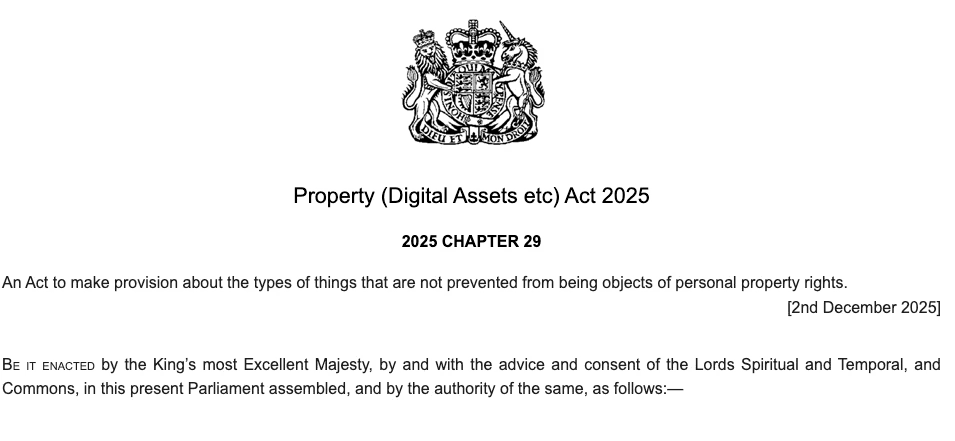
With the passing of the Property (Digital Assets etc) Act 2025, the UK has officially recognised digital assets as personal property. On the surface that sounds like a legal technicality, most people assumed we already “owned” our crypto but this is a far bigger shift.
Yesterday was a quiet day in Parliament, but a loud one for property law.
With the passing of the Property (Digital Assets etc) Act 2025, the UK has officially recognised digital assets as personal property. On the surface that sounds like a legal technicality, most people assumed we already “owned” our crypto but this is a far bigger shift.
For centuries, English law has only recognised two categories of personal property:
1. Things in possession — physical items you can hold.
2. Things in action — legal rights you can enforce.
Crypto has never fitted neatly into either. It isn’t tangible, and it isn’t merely a right against a counterparty. It exists independently of any legal system. Lawyers have been forcing it into outdated definitions, and the results have been… messy.
This Act finally acknowledges reality: digital assets now sit in a new, statutory “third category” of personal property.
Here’s why that matters for private clients, fiduciaries, and the wider wealth sector.
1. Estate Planning Is Now Unavoidable
Before this Act, there was a genuine question: If an asset isn’t clearly defined as property, can it even be inherited? That uncertainty placed crypto in a grey zone, especially awkward for executors trying to understand their obligations.
The Act removes that ambiguity. Digital assets are now unambiguously part of the estate.
This raises the bar for professional executors:
You must identify digital holdings.
You must secure them.
You must distribute them properly.
Simply not asking clients about crypto is no longer defensible. If your firm doesn’t have a process for discovering, documenting, and recovering keys, the estate is at risk — and so is your firm.
2. Fraud Recovery Now Has Real Teeth
Historically, fraud cases involving crypto hit a strange hurdle: if the law wasn’t certain crypto was “property,” could it technically be stolen?
That argument has now evaporated.
By recognising digital assets as property, the Act strengthens the courts’ ability to issue:
Freezing injunctions
Proprietary claims
Tracing orders
For trustees or UHNW families holding high-value positions, this gives something they’ve wanted for years: statutory backing that the courts can intervene when things go wrong.
3. A Green Light for Professional Trustees
Many trustees have been wary of touching digital assets. Not because of the technology per se, but because the legal foundations felt fragile. How do you hold something in trust when the law itself won’t fully recognise it?
This Act resolves that tension.
Expect to see more private offices, trust structures, and fiduciaries incorporating digital assets into long-term planning — not as an awkward side note, but as a legitimate part of the balance sheet.
The Evoke View
At Evoke, we’ve always approached digital assets as property that must be:
secured,
documented,
discoverable, and
transferable across generations.
That’s why our platform combines multi-signature governance, inheritance workflows, and continuity tooling to solve the practical challenges the law alone can’t fix.
The law is finally catching up with what the technology has been for over a decade.
The real question is whether your firm’s internal processes have caught up with the law.